

Customer Retention Tools: Unlocking the Benefits of Loyalty Programs for Your Business
Estimated reading time: 8 minutes
Key Takeaways
- Loyalty programs can increase Customer Lifetime Value (CLV) by inspiring more frequent purchases.
- They serve as rich data-collection engines, empowering highly personalized marketing.
- Advocacy and referrals from satisfied members lower acquisition costs dramatically.
- The right program transforms one-time buyers into engaged brand communities.
Table of Contents
- Introduction
- Understanding Loyalty Programs & Their Core Advantages
- Evaluating the Core Benefits
- Conclusion
- FAQ
Introduction
Customer loyalty programs have become essential tools for businesses seeking sustainable growth in today’s competitive marketplace. The benefits of a loyalty program extend far beyond simple point accumulation, creating meaningful connections that drive measurable results.
Understanding the advantages of loyalty programs is crucial for any business leader considering this investment. Such programs serve as powerful customer-retention strategies that reward repeat customers through points, discounts, special offers, and exclusive experiences.
“It costs five times more to attract a new customer than to keep an existing one.” — Marketing rule of thumb
The modern landscape has shifted toward retention rather than pure acquisition, making why have a loyalty program a critical question for success (loyalty program business case).
Understanding Loyalty Programs & Their Core Advantages
A loyalty program is a structured business strategy designed to reward repeat customers for ongoing engagement. Points, tiers, discounts, and experiential perks all cultivate stronger emotional connections.
Key Advantages
- Improved Customer Acquisition – Differentiating with unique incentives draws in new shoppers.
- Enhanced Customer Retention – Selling to existing customers is 60-70 % easier than winning new ones.
- Boosted Engagement – Personalization & gamification drive real engagement and repeat interactions.
Case studies continually show how systematic rewards transform one-time buyers into brand advocates (Fielo business case eBook; Antavo case study).
Evaluating the Core Benefits
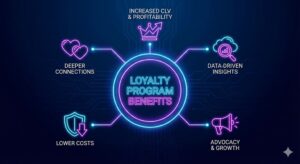
Increased Customer Lifetime Value
Perhaps the most significant upside is the rise in CLV (benefits of loyalty programs). Members consolidate spending with the brands that reward them, raising average order value and purchase frequency.
Enhanced Data Collection
Every program interaction delivers insight on preferences and behaviors. With seamless e-commerce integration (the connected store), businesses build richer customer profiles for laser-targeted campaigns.
Higher Advocacy & Referrals
Loyal members naturally champion brands. Rewarding social engagement boosts organic reach while lowering acquisition costs.
Reduced Marketing Spend
Retaining customers through rewards costs less than wide-net advertising. Budget saved on acquisition can be reinvested in deeper member experiences.
Conclusion
From higher CLV to stronger advocacy, the advantages are undeniable. A well-structured loyalty program tailored to your audience positions your business for sustainable growth and a true competitive edge.
FAQ
Q1: How long does it take to see ROI from a loyalty program?
A1: Many brands notice measurable ROI within 6-12 months as repeat-purchase rates climb.
Q2: Do loyalty programs work for small businesses?
A2: Absolutely. Scalable, digital solutions let even micro-brands reward and retain their best customers cost-effectively.
Q3: What’s the biggest mistake companies make when launching a program?
A3: Focusing solely on discounts. Modern consumers crave personalized experiences, community, and status-based rewards.
Latest posts


Estimated reading time: 8 minutes Key Takeaways Loyalty programs can increase Customer Lifetime…
Read more
Estimated Reading Time 8 minutes Key Takeaways Loyalty programs dramatically enhance customer retention…
Read more
Estimated reading time: 9 minutes Key Takeaways Loyalty programs cultivate deeper customer relationships…
Read more
FOLLOW US


