

What is Customer Lifetime Value and the Benefits of a Loyalty Program for Your Business
Estimated Reading Time
8 minutes
Key Takeaways
- Loyalty programs dramatically enhance customer retention and boost repeat purchases.
- Data collected through rewards initiatives fuels hyper-personalised marketing campaigns.
- Gamification and experiential rewards increase engagement far beyond traditional discount models.
- Lower acquisition costs and stronger brand advocacy drive long-term, sustainable growth.
Table of Contents
- Introduction
- Understanding Loyalty Programs & Core Advantages
- Evaluating the Core Benefits
- Implementation Tips for Maximum ROI
- Conclusion
- FAQ
Introduction
Customer loyalty programs have become essential tools for businesses seeking sustainable growth in today’s competitive marketplace. The benefits of a loyalty program extend far beyond simple point accumulation, creating meaningful connections between brands and their customers while driving measurable business results.
Understanding the advantages of loyalty programs is crucial for any business leader considering this strategic investment. These programs serve as powerful customer retention strategies that reward repeat customers through points systems, discounts, special offers, and exclusive experiences.
The modern business landscape has shifted dramatically toward retention rather than pure acquisition. Organizations now recognise that sustaining long-term relationships delivers greater value than constantly chasing new customers, making why have a loyalty program a critical question for business success.
“It can cost five times more to attract a new customer than to retain an existing one.” – PropelloCloud
Understanding Loyalty Programs & Their Core Advantages
A loyalty program is a structured business strategy designed to reward repeat customers for their continued engagement and purchases. By offering value through points, perks, or experiences, brands create a powerful incentive loop that fosters long-term commitment.
Key Advantages of Loyalty Programs
- Improved Customer Acquisition – Unique incentives differentiate your brand in crowded marketplaces, drawing new customers in.
- Enhanced Customer Retention – Selling to existing customers is 60-70 % easier than to new prospects, underscoring the value of retention.
- Boosted Engagement – Gamified touchpoints and gamification elements keep customers interacting with your brand.
Evaluating the Core Benefits of a Loyalty Program
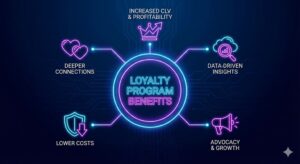
1. Increased Customer Lifetime Value (CLV)
One of the most significant benefits of a loyalty program is the dramatic uplift in CLV. By encouraging repeat purchases and higher average order values, loyalty initiatives directly increase revenue per customer.
2. Enhanced Customer Data Collection
Every swipe, scan, or click within a program captures valuable behavioural data. Armed with this insight, brands create tailored campaigns that delight customers with the right offer at the right time.
3. Higher Advocacy & Referrals
Satisfied members often turn into vocal advocates. Loyal customers amplify reach through word-of-mouth marketing, bringing in new, highly qualified prospects at minimal cost.
4. Reduced Marketing & Acquisition Costs
Retention is simply cheaper. By focusing budget on keeping existing customers happy, businesses lower cost-per-acquisition and free up resources for innovation.
5. Stronger Emotional Connection
Rewards trigger the “dopamine effect,” forging positive emotions that tie customers closer to your brand. This emotional loyalty withstands price wars and competitive noise.
6. Competitive Differentiation
A well-designed program becomes a moat competitors struggle to cross, especially when experiential rewards create memories money alone can’t buy.
Implementation Tips for Maximum ROI
- Align Rewards with Core Brand Values – Offer perks that reinforce what makes your business unique.
- Keep the Earning Rules Simple – Clear, transparent mechanics encourage quicker adoption.
- Leverage Tiered Structures – Status levels motivate members to climb the ladder.
- Integrate Omnichannel Touchpoints – Ensure customers can earn and redeem both online and in-store.
- Measure & Iterate – Use KPIs like participation rate, redemption frequency, and CLV to refine strategy.
Conclusion
A thoughtfully designed loyalty program isn’t a cost—it’s an investment. When executed correctly, loyalty initiatives increase revenue, cut marketing expenses, and transform customers into life-long brand advocates. By focusing on meaningful rewards, robust data strategies, and seamless omnichannel experiences, businesses create a growth engine that compounds year after year.
FAQ
How much does it cost to launch a loyalty program?
Costs vary based on scale and complexity. Cloud-based solutions start as low as a few hundred dollars per month, while enterprise platforms can run into the tens of thousands.
What KPI should I track first?
Begin with participation rate—the percentage of customers who enrol—and redemption frequency to gauge early engagement.
Are points still effective in 2024?
Yes, but they work best alongside experiential rewards and gamified elements that keep the programme fresh and exciting.
Can small businesses benefit, or is this just for large enterprises?
Small businesses often see the fastest ROI because they can implement changes quickly and build personal relationships with members.
Latest posts


Estimated reading time: 8 minutes Key Takeaways Loyalty programs can increase Customer Lifetime…
Read more
Estimated Reading Time 8 minutes Key Takeaways Loyalty programs dramatically enhance customer retention…
Read more
Estimated reading time: 9 minutes Key Takeaways Loyalty programs cultivate deeper customer relationships…
Read more
FOLLOW US


