

The Complete Guide to Loyalty Program Examples and Their Benefits for Your Business
Estimated reading time: 8 minutes
Key Takeaways
- Loyalty programs nurture long-term customer relationships and increase revenue.
- They dramatically raise Customer Lifetime Value (CLV) while lowering acquisition costs.
- Rich customer data gained from programs fuels hyper-personalised marketing.
- Gamification and exclusive rewards spark deeper engagement and organic referrals.
- Proper metrics, segmentation, and continuous optimisation are vital for success.
Table of Contents
- Introduction
- Understanding Loyalty Programs & Core Advantages
- Evaluating the Core Benefits of a Loyalty Program
- Implementing a High-Impact Loyalty Program
- Best Practices & Common Pitfalls
- Conclusion
- FAQ
Introduction
Customer loyalty programs have become *essential* tools for businesses seeking sustainable growth in today’s competitive marketplace. The benefits of a loyalty program extend far beyond simple point accumulation, creating meaningful connections between brands and their customers while driving measurable business results.
Understanding the advantages of loyalty programs is crucial for any business leader considering this strategic investment. These programs serve as powerful customer-retention strategies that reward repeat customers through points, discounts, special offers, and exclusive experiences.
The modern business landscape has shifted dramatically toward retention rather than pure acquisition. Organisations now recognise that sustaining long-term relationships delivers greater value than constantly chasing new customers. This fundamental change makes *why have a loyalty program* a critical question for business success.
“It can cost up to five times more to acquire a new customer than to keep an existing one.” – Propello Cloud business case report
Understanding Loyalty Programs & Their Core Advantages
A loyalty program is a structured business strategy designed to reward repeat customers for their continued engagement and purchases. These programs create tangible value through mechanisms such as points systems, discounts, special offers, and exclusive experiences that make customers feel valued and appreciated.
The primary function of loyalty programs is to drive engagement and retention through systematic reward distribution. When customers receive recognition for their interactions, they develop stronger emotional connections to the brand.
Key Advantages
- Improved Customer Acquisition — unique incentives differentiate brands in crowded markets, attracting first-time buyers.
- Enhanced Customer Retention — selling to existing customers is *60–70 % easier* than to new prospects.
- Boosted Customer Engagement — modern programs use personalisation and gamification elements to multiply interactions.
Strategically implemented loyalty programs transform one-time buyers into *brand evangelists* while building communities around shared values.
Evaluating the Core Benefits of a Loyalty Program
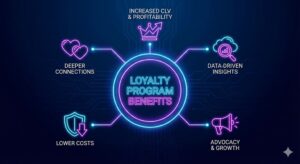
Increased Customer Lifetime Value
One of the most significant benefits of a loyalty program is the dramatic rise in CLV. Members buy more often and spend more per visit, consolidating purchases with the brand.
Enhanced Customer Data Collection
Loyalty platforms double as rich data engines, capturing every interaction and preference. This insight powers laser-targeted campaigns, smarter product development, and *predictive* retention models.
Higher Advocacy & Referrals
Satisfied members become vocal champions, amplifying word-of-mouth marketing. Referred customers arrive pre-qualified and often boast higher lifetime value.
Reduced Marketing & Acquisition Costs
Retaining loyal customers is substantially cheaper than constant prospecting. Funds saved can be reinvested into innovation, premium rewards, or new channel experiments.
Implementing a High-Impact Loyalty Program
- Define Objectives — set measurable goals (e.g., 15 % lift in repeat purchase rate within 12 months).
- Choose a Reward Structure — points, tiers, cashback, experiential perks, or hybrids.
- Integrate Technology — select platforms that unify e-commerce, POS, and CRM data.
- Map the Customer Journey — identify *moments of delight* where rewards make the biggest impact.
- Promote Relentlessly — use email, social, in-store signage, and staff training to drive enrolment.
- Measure & Optimise — track KPIs like enrolment rate, redemption rate, CLV lift, and churn.
Best Practices & Common Pitfalls
- Keep it simple. Confusing rules deter participation.
- Balance *instant gratification* (small, frequent rewards) with *long-term milestones* (elite tiers).
- Prioritise mobile—60 % of redemptions now occur on smartphones.
- Segment communication; a first-time buyer should not receive the same message as a VIP.
- Avoid “reward inflation” where points lose perceived value over time.
- Regularly survey members; their feedback is your optimisation goldmine.
Conclusion
Loyalty programs are no longer optional; they are *mission-critical* growth engines. By fostering enduring relationships, capturing actionable data, and turning customers into advocates, these programs deliver outsized ROI for businesses willing to invest thoughtfully.
As competition intensifies, the brands that win will be those that transition from transactional to relational thinking—rewarding not just purchases, but *people*.
FAQ
Q1: How quickly can a loyalty program show ROI?
Most businesses begin noticing measurable uplift in repeat purchase rate within 3–6 months, provided enrolment marketing is robust.
Q2: What industries benefit most from loyalty programs?
Retail, hospitality, e-commerce, fitness, and even B2B software firms have all documented significant gains.
Q3: Are discounts the only effective reward?
No. Experiential perks, early access, charity donations, and gamified badges often create stronger emotional bonds than pure discounts.
Q4: How big should my budget be?
Allocate 1–3 % of revenue generated by the program back into rewards and technology—adjust as data validates performance.
Q5: Can small businesses compete with enterprise programs?
Absolutely. Agility allows small brands to craft *hyper-personalised* experiences larger companies struggle to replicate.
Latest posts


Estimated reading time: 8 minutes Key Takeaways Loyalty programs can increase Customer Lifetime…
Read more
Estimated Reading Time 8 minutes Key Takeaways Loyalty programs dramatically enhance customer retention…
Read more
Estimated reading time: 9 minutes Key Takeaways Loyalty programs cultivate deeper customer relationships…
Read more
FOLLOW US


